
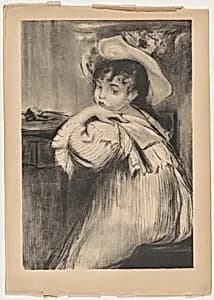
Petite fille (Young Girl)
Medium
lithograph in black on thin laid brown paper
Classification
Portfolio
Department
CG-E
Museum
National Gallery of Art, Washington, D.C.
Credit
Virginia and Ira Jackson Collection, gift in memory of Virginia H. Jackson
Accession Number
1996.151.111
Rights
Public Domain
Art Historical Context
Jacques-Émile Blanche's *Petite fille (Young)*, created in 1895, the delicate charm of childhood through the refined medium of black lithograph on thin laid brown paper. Blanche, a prominent French portraitist of the fin-de-siècle era, was renowned for his elegant depictions of Parisian society figures, often blending influences from Impressionism and Symbolism. This intimate work, housed in the National Gallery of's CG-E Department as part of a portfolio classification, exemplifies his skill in printmaking during a time when lithography allowed artists to achieve painterly effects with remarkable subtlety and tonal depth. Lithography, invented in the late 18th century, flourished in 19th-century France as a democratic medium, bridging fine art and illustration. Blanche's choice of thin laid paper—characterized by its subtle chain lines and textured surface—enhances the lithograph's fragility and warmth, evoking the ephemerality of youth. Printed in a single bold black ink, the image likely renders the young girl's features with soft modeling and expressive lines, inviting viewers to ponder the innocence of the Belle Époque. Generously gifted from the Virginia and Ira Jackson Collection in memory of Virginia H. Jackson, this piece offers a window into Blanche's world, where everyday subjects like a young girl became emblems of refined beauty and cultural grace. A testament to the era's artistic innovation, it reminds us how prints preserved the fleeting moments of life for generations to admire.