
Petites Barques
19th century
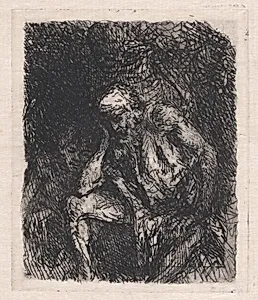
Medium
Etching
Dimensions
Sheet: 9 3/8 × 12 3/16 in. (23.8 × 30.9 cm) Image: 4 5/16 × 5 1/16 in. (10.9 × 12.8 cm)
Classification
Prints
Department
Drawings and Prints
Museum
Metropolitan Museum of Art, New York, NY
Credit
Gift of Mauric Le Garrec, 1922
Accession Number
22.91.2
Rights
Public Domain
Art Historical Context
**Petites Barques** is a delicate etching by Charles Jacque, a prominent 19th-century French associated with the Barbizon. Created during an era when artists sought inspiration directly from nature, Jacque specialized in pastoral scenes featuring animals, peasants, and rural life. This print, translating to "Little Boats," likely captures a serene waterway moment, evoking the tranquility of the French countryside or coast. Its modest image size—4 5/16 × 5 1/16 inches—invites intimate viewing, while the larger sheet (9 3/8 × 12 3/16 inches) frames it elegantly. Etching, Jacque's favored medium, allowed for intricate line work through acid-etched copper plates, producing rich tonal variations and textures that mimic drawing. This technique was revolutionary in the 19th century, democratizing art by enabling affordable multiples while showcasing an artist's mastery of light and shadow. Jacque's prints, like this one from the Metropolitan Museum of Art's Drawings and Prints department, reflect the Realist movement's emphasis on everyday beauty over romantic idealization. Generously gifted by Maurice Le Garrec in 1922, **Petites Barques** exemplifies how 19th-century printmaking bridged fine art and accessibility, offering museum visitors a window into Jacque's observant eye for nature's quiet poetry. A charming gem for print enthusiasts!
About the Artist
Charles Jacque · 1813–1894
Charles-Émile Jacque (1813–1894) was a pioneering French painter, engraver, and illustrator whose career bridged the worlds of printmaking and pastoral painting. Born in Paris amid a difficult childhood, he apprenticed at age seventeen to a map engraver, mastering drypoint technique and producing his first etching in 1830—a copy of a head after Rembrandt. After serving seven years in the French Ar...