
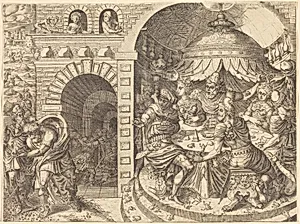
Pharaoh and the Plague of Frogs
1501 to 1550
Medium
engraving
Dimensions
sheet: 16.2 × 22 cm (6 3/8 × 8 11/16 in.)
Classification
Department
CG-E
Museum
National Gallery of Art, Washington, D.C.
Credit
Rosenwald Collection
Accession Number
1943.3.8830
Rights
Public Domain
Art Historical Context
Behold the dramatic engraving *Pharaoh and the of Frogs* by Pierre Woiriot, masterful 16th-century (ca. 1501–1550) from the National of Art's Rosenwald. Measuring a modest 16.2 × 22 cm, this intimate sheet captures a pivotal biblical moment from the Book of Exodus (8:1–15), where God unleashes a plague of frogs upon Egypt as divine judgment on Pharaoh's refusal to free the Israelites. Woir, a French engraver during the Renaissance, transforms this chaotic miracle into a vivid scene teeming with symbolic power. Engraving, Woiriot's chosen medium, exemplifies the era's innovative printmaking techniques. By incising fine lines into a metal plate and inking it for transfer to paper, artists like him could produce multiple impressions, democratizing religious imagery for homes, churches, and scholars amid the Reformation's fervor. This method allowed intricate details—frogs swarming palaces, Pharaoh's defiant posture—to shine with precision and depth, blending Northern European precision with French elegance. As part of the Prints department (CG-E), this work highlights engraving's role in visual storytelling, immersing viewers in ancient narratives that shaped Western culture. A testament to faith and retribution, it invites us to ponder timeless themes of obedience and consequence.