
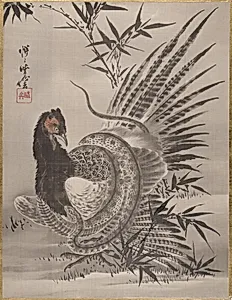
Pheasant Caught by a Snake
ca. 1887
Medium
Album leaf; ink and color on silk
Dimensions
14 1/4 x 10 7/8 in. (36.2 x 27.6 cm)
Classification
Paintings
Culture & Period
Japan · Meiji period (1868–1912)
Department
Asian Art
Museum
Metropolitan Museum of Art, New York, NY
Credit
Charles Stewart Smith Collection, Gift of Mrs. Charles Stewart Smith, Charles Stewart Smith Jr., and Howard Caswell Smith, in memory of Charles Stewart Smith, 1914
Accession Number
14.76.61.17
Rights
Public Domain
Tags
Art Historical Context
In the late Meiji period1868–1912), as Japan rapidly modernized under Western influences, artist Kawanabe Kyōsai (1831–1889) remained a vibrant champion of traditional Japanese painting. Known for his exuberant, satirical style blending ukiyo-eblock traditions with bold ink brushwork and whimsical humor, Kyōsai often depicted animals with anthropomorphic flair. *Pheasant Caught by Snake* (ca. 1887), an intimate album leaf in ink and color on silk14¼ × 10⅞ in.), captures this mastery. The delicate silk surface allows for luminous colors and fluid lines, typical of personal albums exchanged among artists and collectors, emphasizing portability and poetic intimacy over grand scrolls. This scene of a snake ensnaring a pheasant evokes nature's raw drama, a common motif in Japanese art symbolizing life's precarious balance or impermanence (mujō). Kyōsai's dynamic composition, with twisting forms and expressive tension, infuses tension with his signature playfulness—perhaps a sly nod to human folly amid Japan's era of change. Donated to the Metropolitan Museum of Art in 1914 from the Charles Stewart Smith Collection, it exemplifies Meiji-era fusion of Edo-period vitality and refined technique, inviting viewers to ponder predator and prey in silk's subtle glow.
About the Artist
Kawanabe Kyōsai 河鍋暁斎 (Japanese) · 1831 –1889
Japanese, 1831–1889