
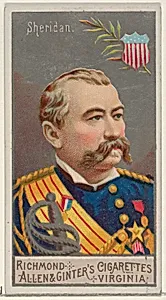
Philip Henry Sheridan, from the Great Generals series (N15) for Allen & Ginter Cigarettes Brands
Medium
Commercial color lithograph
Dimensions
Sheet: 2 3/4 x 1 1/2 in. (7 x 3.8 cm)
Classification
Prints|Ephemera
Department
Drawings and Prints
Museum
Metropolitan Museum of Art, New York, NY
Credit
The Jefferson R. Burdick Collection, Gift of Jefferson R. Burdick
Accession Number
63.350.201.15.38
Rights
Public Domain
Tags
Art Historical Context
Step into the vibrant world of 19th-century American ephemera with this petite commercial color lithograph,Philip Henry Sheridan, from the Great Generals series (N15)*, produced in 1888 by Allen & Ginter in collaboration with George S. & Sons. Measuring just 2 3/4 x 1 1/2 inches, this card was designed as a promotional insert for Allen & Ginter cigarette packs part of a popular series celebrating military heroes. These collectible cards, now treasured in The Metropolitan Museum of Art's Jefferson R. Burdick Collection, captured the public's fascination with Civil War legends during the Gilded Age. General Philip Henry Sheridan, a storied Union cavalry commander, is depicted here in a style typical of the era's commercial portraiture—bold, patriotic, and instantly recognizable. Allen & Ginter's innovative use of chromolithography brought vivid colors and fine details to mass-produced prints, making high-quality imagery accessible and fueling the cigarette card collecting craze among all ages. This medium transformed everyday tobacco products into cultural touchstones, blending advertising with education on American history. As a piece of prints and ephemera, it highlights the intersection of commerce and commemoration, preserving Sheridan's legacy in a format that was both disposable and desirable. Today, it reminds us how art permeated popular culture, turning pocket-sized portraits into portals to the past.
About the Artist
Allen & Ginter|George S. Harris & Sons
Allen & Ginter, the pioneering American tobacco firm based in Richmond, Virginia, emerged around 1880 from the partnership of John F. Allen and Lewis Ginter, evolving from Allen's earlier John F. Allen & Company. Allen retired in 1882, succeeded by John Pope, yet the brand endured under Ginter's leadership, employing over 1,100 workers—mostly women—for hand-rolled cigarettes by 1886. Ginter, a Dut...