
Photograp
1849–51
Medium
Salted paper print
Dimensions
Image: 6 1/4 × 8 3/8 in. (15.8 × 21.2 cm) Mount: 8 3/8 in. × 11 9/16 in. (21.2 × 29.4 cm)
Classification
Photographs
Department
Photographs
Museum
Metropolitan Museum of Art, New York, NY
Credit
Gilman Collection, Museum Purchase, 2005
Accession Number
2005.100.967.1 (20)
Rights
Public Domain
Art Historical Context
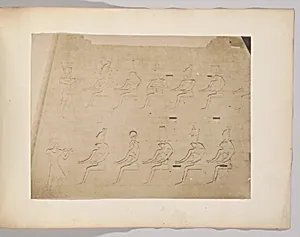
Maxime Du Camp's *Photograp* (1849–51), a salted paper print measuring 6¼ × 8⅜ inches, captures the dawn of photography's power to document the world. Created during Du Camp's transformative journey through Egypt, Nubia, Palestine, and Syria alongside writer Gustave Flaubert, this image exemplifies early calotype positives. As one of the first photographers systematically record ancient monuments, Du Camp brought distant wonders to European audiences, publishing over 400 such prints in his groundbreaking 1852 album *Egypte, Nubie, Palestine et Syrie*. The salted paper print technique, pioneered by William Henry Fox Talbot, involved coating paper with salt and silver iodide, then fixing the image with a chemical bath. This process yielded soft, textured tones ideal for atmospheric landscapes but prone to fading—highlighting photography's nascent challenges and innovations. Du Camp's work bridged art and archaeology, preserving sites like the pyramids for posterity. Housed in The Metropolitan Museum of Art's Gilman Collection, this piece underscores photography's role in 19th-century exploration, transforming how we visualize history. Visitors, imagine holding a fragile window to 1850s Egypt!
About the Artist
Maxime Du Camp · 1822–present
Maxime Du Camp (1822–1894) was a pioneering French photographer and writer whose adventurous spirit and technical innovation bridged literature and visual art during the mid-19th century. Born in Paris on February 8, 1822, to a prosperous family—his father a successful surgeon—Du Camp received a solid bourgeois education at the Collège Bourbon (now Lycée Condorcet), where he cultivated interests i...