
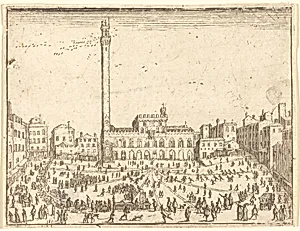
Piazza Publicca, Siena
Medium
etching on laid paper
Dimensions
sheet (trimmed to plate mark): 7.6 × 9.9 cm (3 × 3 7/8 in.)
Classification
Department
CG-E
Museum
National Gallery of Art, Washington, D.C.
Credit
R.L. Baumfeld Collection
Accession Number
1969.15.358
Rights
Public Domain
Art Historical Context
Behold the intimate etching *Piazza Publicca,*, a captivating glimpse into 17th-century Italian urban life. Created by an anonymous Italian artist around 1610–1660 (formerly attributed to the renowned etcher Jacques Callot), this small print measures just 7.6 × 9.9 cm, trimmed to the plate mark, on laid paper—a period staple valued for its subtle texture that enhanced ink retention in fine-line techniques. Etching, a revolutionary printmaking method involving acid-bitten metal plates, allowed for exquisite detail in bustling scenes like Siena's famed public square (likely the Piazza del Campo, site of the thrilling Palio horse races). This work exemplifies the era's fascination with topography and daily spectacle, capturing architecture and activity with precision suited to collectors' albums. The reattribution from Callot, a master of intricate narratives, underscores ongoing art historical scholarship. Housed in the National Gallery of Art's R.L. Baumfeld Collection, this print invites us to ponder Siena's enduring cultural vibrancy—a hub of medieval pageantry preserved in miniature form, bridging viewers to Italy's Renaissance legacy through accessible artistry.