
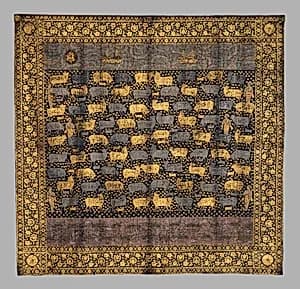
Pichhwai for the Festival of Cows
Unknown Artist
late 18th century
Medium
Painted and printed gold and silver leaf and opaque watercolor on indigo-dyed cotton
Dimensions
97 5/8 x 103 1/8 in. (248 x 262 cm)
Classification
Textiles-Painted and Printed
Culture
India, Deccan, Aurangabad (?)
Department
Asian Art
Museum
Metropolitan Museum of Art, New York, NY
Credit
Purchase, Friends of Asian Art Gifts, 2003
Accession Number
2003.177
Rights
Public Domain
Tags
Art Historical Context
This magnificent *Pichhwai for the Festival of Cows is a late 18th-century devotional textile from India's Deccan region, possiblyangabad. Measuring nearly 8 by 8.5 feet, these vast cloths—known as *pichhwais*, meaning "back picture"—were hung behind altars in Krishna temples during special festivals. This one celebrates the sacred cows associated with Krishna, the divine cowherd, likely for Govardhan Puja, devotees honor bovine protectors of the earth. Crafted on indigo-dyed cotton, the artwork employs intricate techniques: opaque watercolors for vibrant scenes, combined with printed and painted gold and silver leaf for a shimmering, divine glow. The deep blue ground evokes the night sky or Krishna's cosmic realm, while metallic accents highlight cows, pastoral landscapes, and perhaps the god himself amid his herd—symbols of prosperity, motherhood, and non-violence in Hindu tradition. As a rare Deccan example in the Metropolitan Museum of Art's Asian Art collection, this *pichhwai* showcases regional artistry blending painting and printing, bridging temple ritual and folk devotion. Imagine it unfurled in a candlelit shrine, drawing worshippers into Krishna's idyllic world.