
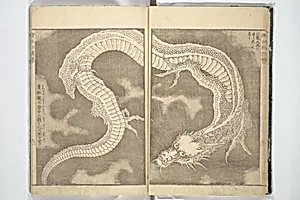
絵本和漢誉|Picture Book on Heroes of China and Japan (Ehon wakan no homare) 絵本和漢誉
1850 (designed ca. 1836; published posthumously)
Medium
Woodblock printed book; ink on paper
Dimensions
9 1/16 × 6 3/8 in. (23 × 16.2 cm)
Classification
Illustrated Books
Culture & Period
Japan · Edo period (1615–1868)
Department
Asian Art
Museum
Metropolitan Museum of Art, New York, NY
Credit
Purchase, Mary and James G. Wallach Foundation Gift, 2013
Accession Number
2013.882
Rights
Public Domain
Tags
Art Historical Context
Katsushika Hokus's *Picture Book on Heroes of China Japan (Ehon wakan no hom)*, designed around 1836 and posthumously in 185, is a captivating woodblock-printed book from Japan's Edo period (16151868). This compact volume (9 1/16 × 6 3/8 in.), inked on paper, showcases Hokusai's mastery ofkiyo-e—the "pictures of the floating world" style that blended dynamic compositions with vivid storytelling. Featuring legendary heroes from Chinese and Japanese lore, often intertwined with mythical dragons, it reflects the era's fascination with epic tales and moral exemplars. Hokusai, the renowned artist behind *The Great Wave off Kanagawa*, created this work late in his prolific career, pushing woodblock techniques to evoke motion and drama. Ehon, or picture books, were prized Edo publications that made art accessible beyond elites, printed via intricate carving and multi-color layering for bold contrasts. Published after Hokusai's death in 1849, it honors his enduring legacy in blending Eastern myths with innovative printmaking. Visitors will appreciate how this book bridges cultures, celebrating valor through fantastical imagery—perfect for glimpsing Edo Japan's vibrant print culture at the Metropolitan Museum of Art.
About the Artist
Katsushika Hokusai 葛飾北斎 (Japanese) · 1760 –1849
Japanese, Tokyo (Edo) 1760–1849 Tokyo (Edo)