
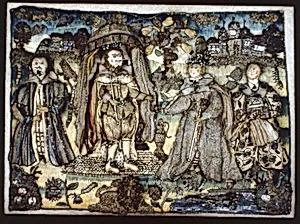
Picture Depicting the Queen of Sheba before King Solomon
1601/50
Medium
Silk, warp-float faced 7:1 satin weave; appliquéd with silk, warp-float faced 7:1 satin and plain weaves; painted; embroidered with silk, silk 2:2 twill oblique interlaced tapes, gilt- and silvered-metal-strip-wrapped silk, and gilt- and silvered-metal strips, coils, wires and paillettes in satin, single satin, raised stem and a variety of buttonhole stitches; laid work and couching; feathers; glass beads and seed pearls
Dimensions
29.3 × 38.8 × 6.4 cm (11 1/2 × 15 1/4 × 2 1/2 in.)
Classification
needlework (visual works)
Department
Textiles
Museum
Art Institute of Chicago
Accession Number
15152
Rights
Public Domain
Art Historical Context
This exquisite needlework picture, created between 1601 and 1650, captures the timeless biblical tale of the Queen of Sheba's audience with King Solomon, a story of wisdom, splendor, and cultural exchange from the Old Testament. Housed in the Art Institute of Chicago's Textiles Department, this 29.3 × 38.8 cm framed panel transforms a sacred narrative into a luxurious pictorial tapestry, likely crafted for a devout or affluent household during Europe's Baroque era, when opulent religious imagery flourished. The artwork's technical brilliance lies in its multilayered construction: a silk warp-float faced 7:1 satin weave base is appliquéd with matching silks, then meticulously painted and embroidered using silk twills, gilt- and silvered-metal strips, wires, coils, paillettes, feathers, glass beads, and seed pearls. Varied stitches—satin, raised stem, buttonhole, laid work, and couching—create shimmering depth and texture, elevating embroidery from mere craft to high art. Such lavish materials underscore the piece's status as virtuoso needlework, blending painting, appliqué, and metalwork in a rare fusion. This anonymous masterpiece reflects the era's fascination with exotic biblical queens and Solomon's legendary court, symbolizing divine judgment and global tribute. Its survival highlights the enduring cultural reverence for the Sheba-Solomon legend across Jewish, Christian, and Islamic traditions, inviting visitors to marvel at the unseen labor of skilled hands.
About the Artist
Unknown
The artist designated as "Unknown" in our virtual museum's collection exemplifies a poignant chapter in art history: creators whose identities have faded into obscurity despite the enduring power of their work. With only one known artwork attributed to them in our holdings, this figure represents countless anonymous hands that shaped visual culture across centuries. Museums worldwide, including th...