
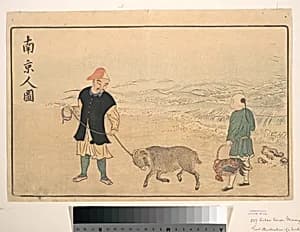
Picture of a man of Nankin
1789
Medium
Woodblock print; ink and color on paper
Dimensions
10 x 14 7/8 in. (25.4 x 37.8 cm)
Classification
Prints
Culture & Period
Japan · Edo period (1615–1868)
Department
Asian Art
Museum
Metropolitan Museum of Art, New York, NY
Credit
Rogers Fund, 1918
Accession Number
JP527
Rights
Public Domain
Tags
Art Historical Context
**Picture of a Man ofankin** by Kuwagataisai (1789) is a captivating woodblock print from Japan's Edo period (16151868), showcasing the artist's skill in the ukiyo-e tradition—"pictures of the floating world." intimate work, measuring 10 x 14 7/8 inches, uses ink and color on paper depict a man from Nankin (an old name for Nanjing, China possibly a merchant or traveler, alongside lambs. Created through the meticulous woodblock process—involving carved blocks for each color layer—it reflects the era's innovative printing techniques that made art accessible to everyday people. During the Edo period, Japan was largely isolationist under the Tokugawa shogunate, yet limited trade with China via Nagasaki introduced exotic figures into popular culture. Keisai, a follower of ukiyo-e master Kitao Masanobu, often portrayed actors, beauties, and genre scenes; this print likely captures cultural curiosity about Chinese visitors. The inclusion of lambs adds an intriguing pastoral touch, evoking themes of trade in wool or livestock, blending Eastern and symbolic motifs. Housed in the Metropolitan Museum of Art's Asian Art department (Rogers Fund, 1918), this print highlights ukiyo-e's global influence and its role in documenting diverse humanity. A window into 18th-century cross-cultural encounters, it invites visitors to ponder the worlds beyond Japan's borders.