
Piece
Unknown Artist
1735?–?45
Medium
Silk
Dimensions
16 1/2 x 17 3/4 inches (41.9 x 45.1 cm)
Classification
Textiles-Woven
Culture
French
Department
European Sculpture and Decorative Arts
Museum
Metropolitan Museum of Art, New York, NY
Credit
Rogers Fund, 1909
Accession Number
09.50.2654
Rights
Public Domain
Tags
Art Historical Context
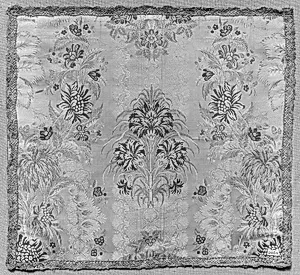
This exquisite silk textile fragment, titled simply *Piece*, hails from France around 1735–1745, a golden era of Rococo elegance during the reign of Louis XV. Woven with masterful precision, it measures 16½ x 17¾ inches and bursts with delicate motifs of flowers and leaves—marks of the period's love for nature-inspired opulence. As a product of France's renowned silk industry, centered in Lyon, this piece originated from a luxury fabric intended for gowns, upholstery, or wall hangings, showcasing the era's fascination with intricate, asymmetrical patterns that evoked pastoral whimsy. The medium of woven silk underscores advanced 18th-century techniques, such as the drawloom, which allowed weavers to create complex, multi-colored designs in a single piece without painting or printing. Its classification as a textile in the Metropolitan Museum of Art's European Sculpture and Decorative Arts department highlights its role in the decorative arts tradition, where textiles were as prized as paintings. Acquired through the Rogers Fund in 1909, this anonymous masterpiece offers a tactile glimpse into French courtly life, where silk symbolized wealth and refinement. Today, it captivates visitors with its luminous sheen and timeless floral beauty, reminding us how everyday luxuries shaped cultural identity in the Ancien Régime.