
Piece
Unknown Artist
late 16th century
Medium
Silk
Dimensions
7 1/4 x 13 inches (18.4 x 33.0 cm)
Classification
Textiles-Woven
Culture
Spanish
Department
European Sculpture and Decorative Arts
Museum
Metropolitan Museum of Art, New York, NY
Credit
Rogers Fund, 1920
Accession Number
20.57.279
Rights
Public Domain
Tags
Art Historical Context
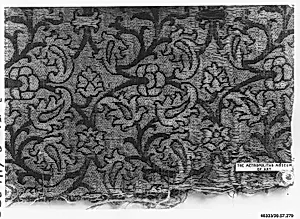
This delicate silk textile fragment, titled simply *Piece*, hails from late 16th-century Spain and exemplifies the opulence of Renaissance-era decorative arts. Measuring just 7¼ x 13 inches, it features intricate woven motifs of flowers and leaves, rendered in vibrant silks that capture the natural world's elegance. Acquired through the Rogers Fund in 1920, it resides in the Metropolitan Museum of Art's Department of European Sculpture and Decorative Arts, classified as a woven textile—a testament to the skilled looms of Spanish workshops. In the context of Spain's Golden Age under the Habsburgs, silk weaving flourished, drawing on Moorish influences from regions like Granada and Valencia, where silk production thrived via trade routes from Asia. These small panels often served as borders for garments, altar cloths, or furnishings, symbolizing wealth and piety. The floral designs reflect the era's fascination with botany, echoing patterns in tapestries and ceramics, and highlight the technical mastery required to interlace fine silk threads on a loom for luminous, textured effects. Though the artist remains unknown, this piece invites visitors to marvel at the anonymous craftsmanship that adorned Europe's elite, preserving a slice of cultural splendor across centuries.