
Piece
Unknown Artist
1760–70
Medium
Silk
Dimensions
L. 19 x W. 12 1/4 inches 48.3 x 31.1 cm
Classification
Textiles-Woven
Culture
French
Department
European Sculpture and Decorative Arts
Museum
Metropolitan Museum of Art, New York, NY
Credit
Gift of The United Piece Dye Works, 1936
Accession Number
36.90.1424
Rights
Public Domain
Tags
Art Historical Context
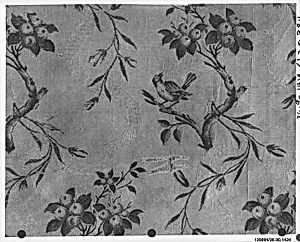
This exquisite silk textile fragment, woven in France between 1760 and 1770, exemplifies the opulent craftsmanship of 18th-century European decorative. Measuring just 19 by 12¼ inches, it likely served as a sample or panel for luxurious garments, furnishings, or ecclesiastical vestments. Produced during the late Rococo era, when France's Lyon silk industry dominated global luxury textiles, this piece highlights the technical mastery of handloom weaving, where intricate patterns were achieved through complex interlacing of silk threads before the advent of mechanized looms. The design bursts with vibrant motifs of birds amid abundant fruit and lush leaves, evoking the period's delight in nature's bounty and pastoral fantasy. Such naturalistic elements were hallmarks of French silk production, symbolizing fertility, abundance, and the refined tastes of the aristocracy under Louis XV. The unknown artist's skill in rendering these details through weaving—rather than painting—demonstrates the medium's unique ability to create dimensional, shimmering effects that caught the light in grand interiors. Today, this "Piece" resides in The Metropolitan Museum of Art's European Sculpture and Decorative Arts collection, a 1936 gift from The United Piece Dye Works. It offers visitors a tangible glimpse into the elegance of pre-Revolutionary France, where silk was both art and commerce.