
Piece
Unknown Artist
18th–19th century
Medium
Silk
Dimensions
9 3/4 x 4 in. (24.77 x 10.16 cm)
Classification
Textiles-Woven
Culture & Period
Japan · Edo (1615–1868)
Department
Asian Art
Museum
Metropolitan Museum of Art, New York, NY
Credit
Gift of Mr. and Mrs. H. O. Havemeyer, 1896
Accession Number
96.14.286
Rights
Public Domain
Art Historical Context
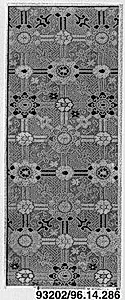
This exquisite silk textile fragment, dating to Japan's Edo period (1615–1868), offers a glimpse into the refined artistry of 18th- to 19th-century weaving traditions. Produced during a time of relative peace and economic prosperity under the Tokugawa shogunate, such pieces reflect the era's flourishing merchant culture, where silk fabrics became symbols of elegance and social status. Woven textiles like this one were essential for garments such as kimonos and obi sashes, showcasing Japan's mastery of intricate loom work. Crafted from luxurious silk, the medium itself highlights advanced techniques developed in regions like Nishijin in Kyoto, where weavers created fine, durable cloths prized for their sheen and texture. At just 9¾ x 4 inches, this small "Piece" likely served as a sample or remnant, preserving the subtle beauty of Edo-era design. Its classification as a woven textile underscores the labor-intensive process, blending functionality with aesthetic harmony central to Japanese aesthetics. Generously gifted to the Metropolitan Museum of Art in 1896 by Mr. and Mrs. H. O. Havemeyer, this artifact invites visitors to appreciate the cultural depth of Asian textiles—where every thread tells a story of innovation and tradition.