
Piece
Unknown Artist
19th century
Medium
Silk
Dimensions
4 3/4 x 6 1/2 in. (12.07 x 16.51 cm)
Classification
Textiles-Velvets
Culture & Period
Japan · Edo (1615–1868)
Department
Asian Art
Museum
Metropolitan Museum of Art, New York, NY
Credit
Gift of Mr. and Mrs. H. O. Havemeyer, 1896
Accession Number
96.14.464
Rights
Public Domain
Art Historical Context
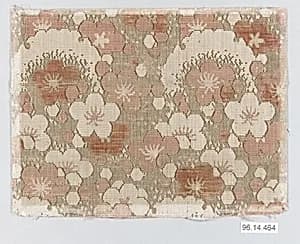
This delicate silk velvet fragment, hailing from Japan's Edo period (1615–8), offers a glimpse into the refined artistry of 19th-century textile production. Measuring just 4¾ x 6½ inches, this small "Piece" exemplifies the exquisite craftsmanship of Japanese velvets, a luxurious medium prized for its plush pile texture and vibrant sheen. During the Edo era—a time of relative peace and flourishing under the Tokugawa shog—textiles like this were essential to daily life, adorning kimonos, theatrical costumes, and ceremonial robes for the merchant class and nobility. Velvet weaving in Japan required masterful techniques, blending silk's natural luster with intricate pile loops cut to create depth and dimension. Though the artist remains unknown, such pieces highlight the anonymous yet highly skilled labor of Edo artisans, who elevated textiles into high art forms. Its classification within the Metropolitan Museum of Art's Asian Art department underscores its cultural value, preserving Japan's legacy of opulent fabric innovation. Generously gifted by Mr. and Mrs. H. O. Havemeyer in 1896, this fragment invites visitors to appreciate the tactile elegance of Edo-era Japan, where even modest remnants whisper tales of imperial splendor and everyday beauty.