
Piece
Unknown Artist
18th–19th century
Medium
Silk
Dimensions
9 3/4 x 5 3/4 in. (24.77 x 14.61 cm)
Classification
Textiles-Woven
Culture & Period
Japan · Edo period (1615–1868)
Department
Asian Art
Museum
Metropolitan Museum of Art, New York, NY
Credit
Gift of Mr. and Mrs. H. O. Havemeyer, 1896
Accession Number
96.14.536
Rights
Public Domain
Art Historical Context
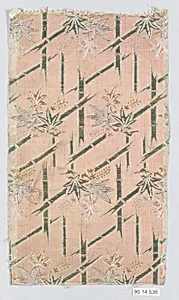
This exquisite silk textile fragment, simply titled *Piece*, hails from Japan's Edo period (1615–1868), a time of relative peace and cultural flourishing under the Tokugawa shogunate. Spanning the 18th to 19th centuries, the Edo era saw vibrant advancements in crafts, including textiles that adorned kimonos, obi sashes, and ceremonial garments. Woven with fine silk threads, this small panel—measuring just 9¾ x 5¾ inches—exemplifies the meticulous craftsmanship of Japanese weavers, who transformed raw materials into luxurious fabrics symbolizing status and artistry. As a woven textile from the Asian Art collection at The Metropolitan Museum of Art, it highlights the technical prowess of Edo-era looms, where intricate patterns were created through complex interlacing of warp and weft. Silk, prized for its luster and durability, was a cornerstone of Japan's export trade and domestic fashion, often dyed with natural pigments for rich, enduring colors. Though the artist remains unknown, such pieces reflect the anonymous mastery of guild-trained artisans, whose work influenced global aesthetics. Generously gifted in 1896 by Mr. and Mrs. H. O. Havemeyer, prominent collectors of Asian treasures, this fragment invites us to appreciate the subtle elegance of everyday Edo luxury— a window into a world where beauty was woven into the fabric of life.