
Piece
Unknown Artist
18th–19th century
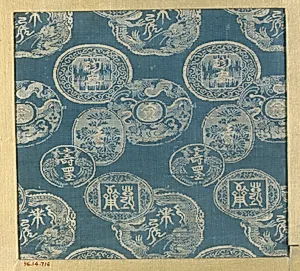
Medium
Silk
Dimensions
6 1/2 x 7 1/4 in. (16.51 x 18.41 cm)
Classification
Textiles-Woven
Culture & Period
Japan · Edo (1615–1868) or Meiji period (1868–1912)
Department
Asian Art
Museum
Metropolitan Museum of Art, New York, NY
Credit
Gift of Mr. and Mrs. H. O. Havemeyer, 1896
Accession Number
96.14.716
Rights
Public Domain
Art Historical Context
This delicate silk textile fragment, titled *Piece*, hails from Japan during the late Edo period (1615–1868) or early Meiji era (1868–1912), a time of artistic refinement and cultural transition. Measuring just 6½ x 7¼ inches, it exemplifies the exquisite woven textiles that were central to Japanese daily life and luxury goods, such as kimonos, obi sashes, and ceremonial robes. Silk weaving reached new heights in these centuries, with artisans employing sophisticated Jacquard-like looms to create intricate patterns symbolizing nature, seasons, or auspicious motifs—hallmarks of Japan's enduring aesthetic of wabi-sabi and refined elegance. In the Edo period, peace and prosperity fueled a boom in textile production, particularly in weaving centers like Kyoto's Nishijin district, where silk was prized for its luster and durability. The shift to Meiji brought Western influences, yet traditional techniques persisted, blending old-world craftsmanship with emerging modernity. As a woven textile, this piece highlights the labor-intensive process of interweaving colored silk threads to form pictorial designs without dyes bleeding—a testament to Japanese ingenuity. Generously gifted to the Metropolitan Museum of Art in 1896 by Mr. and Mrs. H. O. Havemeyer, renowned collectors of Asian art, this fragment offers a tangible glimpse into Japan's textile heritage. Though its full story remains shrouded by its anonymous creator, it invites visitors to appreciate the subtle beauty and cultural depth preserved in such small treasures.