
Piece
Unknown Artist
18th–19th century
Medium
Silk
Dimensions
2 x 4 1/4 in. (5.08 x 10.80 cm)
Classification
Textiles-Woven
Culture
Japan
Department
Asian Art
Museum
Metropolitan Museum of Art, New York, NY
Credit
Gift of Mr. and Mrs. H. O. Havemeyer, 1896
Accession Number
96.14.783
Rights
Public Domain
Art Historical Context
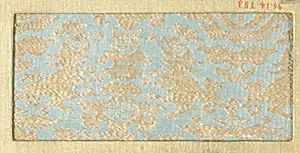
This delicate silk fragment, titled simply *Piece*, hails from Japan during the 18th–19th century, a time spanning the refined Edo period and the transformative early Meiji era. just 2 x 4¼ inches, it exemplifies the meticulous artistry of Japanese textile production, where silk weaving reached extraordinary heights of precision and beauty. Woven textiles like this were integral to daily life and ceremony, adorning kimonos, obi sashes, and decorative screens that reflected social status and aesthetic ideals. As a product of Japan's renowned silk industry—centered in regions like Nishijin in Kyoto—weavers employed sophisticated looms to create lustrous fabrics prized for their durability and sheen. This small-scale example, classified as a woven textile, likely served as a sample or remnant, preserving techniques that blended functionality with subtle elegance. Its survival highlights the era's export trade, which introduced Japanese craftsmanship to global audiences. Generously gifted to The Metropolitan Museum of Art in 1896 by Mr. and Mrs. H. O. Havemeyer, prominent collectors of Asian art, this piece invites us to appreciate the quiet mastery of anonymous artisans whose work continues to inspire wonder in the Asian Art department.