
Piece
Unknown Artist
18th–19th century
Medium
Silk
Dimensions
3 1/2 x 2 3/4 in. (8.89 x 6.99 cm)
Classification
Textiles-Woven
Culture
Japan
Department
Asian Art
Museum
Metropolitan Museum of Art, New York, NY
Credit
Gift of Mr. and Mrs. H. O. Havemeyer, 1896
Accession Number
96.14.922
Rights
Public Domain
Tags
Art Historical Context
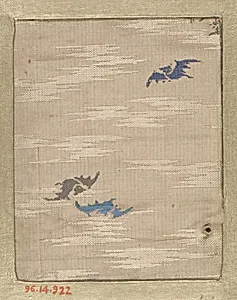
This delicate silk textile fragment, titled *Piece*, hails from Japan during the 18th19th centuries, a period when Edo-period craftsmanship transitioned into Meiji-era innovation. Measuring just 3½ x 2¾ inches, this woven silk exemplifies the precision of Japanese textile arts, where fine threads create intricate patterns on a diminutive scale. Likely a snippet from a larger garment or decorative object, its compact size underscores the portability and everyday elegance of such fabrics in Japanese life. The motif of bats—indicated by the artwork's tags—carries profound cultural symbolism in Japan. Bats, known as *komori*, evoke "fu" (happiness or good fortune) through phonetic wordplay, making them auspicious emblems in textiles, ceramics, and prints. Woven directly into the silk, these designs showcase advanced *nishijin* or similar weaving techniques, where multiple shuttles produced vibrant, reversible patterns without dyes bleeding, a testament to artisanal mastery. Acquired as a gift from Mr. and Mrs. H. O. Havemeyer in 1896, this piece entered The Metropolitan Museum of Art's Asian Art collection early on, reflecting the West's growing fascination with Japonisme. Visitors can appreciate how such humble fragments preserve centuries of cultural optimism and technical brilliance.