
Piece
Unknown Artist
18th–19th century
Medium
Silk
Dimensions
7 1/2 × 6 3/8 in. (19.1 × 16.2 cm)
Classification
Textiles-Woven
Culture
Japan
Department
Asian Art
Museum
Metropolitan Museum of Art, New York, NY
Credit
Gift of Mr. and Mrs. H. O. Havemeyer, 1896
Accession Number
96.14.1748
Rights
Public Domain
Tags
Art Historical Context
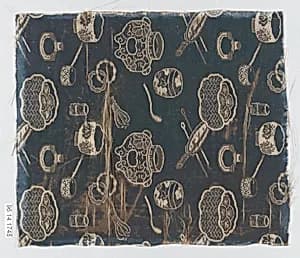
This exquisite woven silk fragment, titled simply *Piece*, hails from Japan during the 18th–19th, a time when textile artistry flourished in the Edo and early Meiji periods. just 7½ × 6⅜ inches (19.1 × 16.2 cm), its compact size suggests it may be a remnant of a larger garment, such as a kimono or obi sash, where silk weaving reached extraordinary levels of refinement. The tag "Bowls" hints at a decorative motif—likely stylized depictions of nested or patterned bowls, a common theme in Japanese textiles symbolizing abundance, domestic harmony, or everyday beauty. Japanese silk weaving techniques during this era, often associated with prestigious centers like Kyoto's Nishijin district, involved intricate looms that interwove colored threads to create pictorial designs without dyeing after weaving. This method allowed for vibrant, durable patterns that captured the elegance of still-life subjects. Silk, prized for its luster and softness, was a luxury material, reflecting Japan's mastery of sericulture and its role in trade and cultural exchange. Generously donated to the Metropolitan Museum of Art in 1896 by Mr. and Mrs. H. O. Havemeyer, renowned collectors of Asian art, this piece offers a window into Japan's textile heritage. Though by an unknown artist, it exemplifies the anonymous brilliance of craft traditions, inviting visitors to appreciate the subtle poetry woven into everyday motifs.