
Piece
Unknown Artist
18th century
Medium
Silk / Compound weave
Dimensions
5 3/4 × 8 1/4 in. (14.6 × 21 cm)
Classification
Textiles-Woven
Culture & Period
Japan · Edo period (1615–1868)
Department
Asian Art
Museum
Metropolitan Museum of Art, New York, NY
Credit
Gift of Kihei Hattori, in memory of his father, Kihei Hattori, 1920
Accession Number
20.148.280
Rights
Public Domain
Tags
Art Historical Context
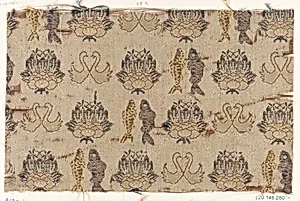
This exquisite silk textile fragment, created by an unknown artist in 18th-century Japan during the Edo period (1615–1868), measures a modest 5¾ × 8¼ inches. Woven in a sophisticated compound technique, it showcases delicate motifs of graceful swans, lively fish, and blooming flowers—hallmarks of Japanese nature-inspired artistry. These elements likely evoke themes of harmony, prosperity, and the fleeting beauty of life, common in Edo-era designs that graced kimonos, screens, and furnishings. The compound weave method, a pinnacle of textile innovation, allowed weavers to create multi-layered patterns with rich depth and color variation on fine silk, reflecting the period's economic stability and artisanal mastery. During the Edo era, a time of peace under the Tokugawa shogunate, such luxury fabrics flourished in urban centers like Kyoto and Edo (modern Tokyo), symbolizing refined taste among merchants and samurai. Now housed in the Metropolitan Museum of Art's Asian Art Department, this piece was a generous gift from Kihei Hattori in 1920, honoring his father. It offers visitors a tactile glimpse into Japan's woven poetry, where every thread tells a story of cultural elegance.