
Piece
Unknown Artist
18th century
Medium
Silk / Compound weave
Dimensions
7 1/8 × 3 1/2 in. (18.1 × 8.9 cm)
Classification
Textiles-Woven
Culture & Period
Japan · Edo period (1615–1868)
Department
Asian Art
Museum
Metropolitan Museum of Art, New York, NY
Credit
Gift of Kihei Hattori, in memory of his father, Kihei Hattori, 1920
Accession Number
20.148.299
Rights
Public Domain
Art Historical Context
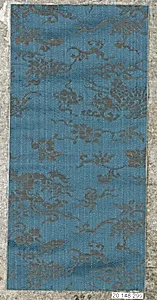
This exquisite silk textile fragment, known simply as *Piece*, hails from Japan's Edo period (1615–8), a time of relative peace and cultural flourishing under the Tokugawa shogunate. Dating to the 18th century, it exemplifies the era's mastery of woven textiles, which were essential for luxurious garments like kimonos and obi sashes. Woven in silk using a compound weave technique—a sophisticated method allowing multiple layers and intricate patterns to be created simultaneously—this small piece (just 7 1/8 × 3 1/2 inches) likely served as part of a larger decorative fabric, showcasing the precision of Japanese artisans. The compound weave's significance lies in its ability to produce complex motifs with depth and texture in a single loom process, a hallmark of Edo textile innovation. Silk, prized for its luster and durability, was a symbol of status, often dyed with vibrant natural pigments and featuring motifs inspired by nature, seasons, or auspicious symbols. Though the exact design details are not specified, such fragments reveal the everyday artistry of urban workshops in cities like Kyoto and Nishijin, where weaving guilds thrived. Generously gifted to the Metropolitan Museum of Art in 1920 by Kihei Hattori, this piece invites us to appreciate the subtlety of Japanese craft—where even a modest remnant whispers tales of elegance and technical brilliance from centuries past.