
Piece
Unknown Artist
17th century
Medium
Silk / Compound weave
Dimensions
1 5/8 × 4 1/8 in. (4.1 × 10.5 cm)
Classification
Textiles-Woven
Culture
Japan
Department
Asian Art
Museum
Metropolitan Museum of Art, New York, NY
Credit
Gift of Kihei Hattori, in memory of his father, Kihei Hattori, 1920
Accession Number
20.148.475
Rights
Public Domain
Art Historical Context
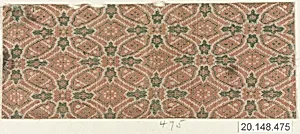
This exquisite silk fragment, titled *Piece*, hails from 17th-century Japan during the Edo period—a time of relative peace and prosperity under the Tokugawa shunate, when textile arts. Measuring just 1 5/8 × 4 1/8 inches, this diminutive woven textile exemplifies the mastery of Japanese weavers, who produced luxurious fabrics for kimonos, obi sashes, and ceremonial garments that signified social status and refined taste. Crafted in a compound weave technique, the piece showcases an advanced method where multiple layers of pattern and color are interlaced in a single loom process, creating intricate designs without supplementary stitching. Silk, prized for its luster and durability, was a hallmark of Japan's renowned weaving centers like Nishijin in Kyoto, blending functionality with artistry. A generous gift to the Metropolitan Museum of Art in 1920 from Kihei Hattori, this small treasure offers a glimpse into Japan's textile heritage, where such fragments preserve the elegance of everyday luxury and the skill of anonymous artisans whose work adorned the elite.