
Piece
Unknown Artist
18th century
Medium
Silk / Compound weave
Dimensions
1 3/8 × 2 3/4 in. (3.5 × 7 cm)
Classification
Textiles-Woven
Culture & Period
Japan · Edo period (1615–1868)
Department
Asian Art
Museum
Metropolitan Museum of Art, New York, NY
Credit
Gift of Kihei Hattori, in memory of his father, Kihei Hattori, 1920
Accession Number
20.148.577
Rights
Public Domain
Tags
Art Historical Context
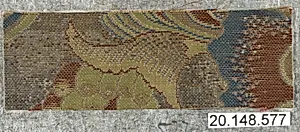
This exquisite silk textile fragment, titled simply *Piece*, hails from Japan's Edo period (1615–8), a time of remarkable artistic flourishing and urban sophistication. Crafted in the 18th century by an unknown artist, this diminutive woven work—measuring just 1 3/8 × 2 3/4 inches—likely served as a sample or detail from a larger garment, such as a kimono ori sash. Its tag of "Leaves" suggests delicate motifs inspired by nature, a hallmark of Japanese design that celebrated seasonal beauty and the transient elegance of flora. The medium, silk with compound weave, showcases advanced weaving techniques perfected during the Edo era. In compound weaving, multiple warp and weft threads interlace to create layered patterns and textures in a single loom process, allowing for intricate, reversible designs without additional embroidery. This method was prized for its precision and luminosity on lustrous silk, reflecting Japan's mastery of textile arts amid growing trade in dyes and fibers. A generous gift to the Metropolitan Museum of Art in 1920 from Kihei Hattori in memory of his father, this piece offers a window into everyday luxury and craftsmanship. Though small, it embodies the Edo period's aesthetic harmony, inviting visitors to appreciate the subtle artistry hidden in fragments of history.