
Piece
Unknown Artist
18th century
Medium
Silk / Compound weave
Dimensions
5 1/8 in. × 4 in. (13 × 10.2 cm)
Classification
Textiles-Woven
Culture & Period
Japan · Edo period (1615–1868)
Department
Asian Art
Museum
Metropolitan Museum of Art, New York, NY
Credit
Gift of Kihei Hattori, in memory of his father, Kihei Hattori, 1920
Accession Number
20.148.650
Rights
Public Domain
Tags
Art Historical Context
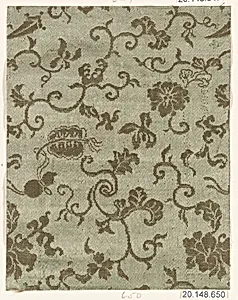
This delicate silk textile fragment, titled *Piece*, hails from 18th-century Japan during Edo period (16151868), a time of relative peace and cultural flourishing. Measuring just 5 1/8 × 4 inches, it exemplifies the exquisite woven textiles produced for clothing, furnishings, and ceremonial items. Adorned with floral motifs—a hallmark of Japanese design symbolizing nature's beauty and seasonal transience—this small artwork captures the refined aesthetic of the era, when urban artisans elevated everyday crafts into high art. Crafted using a compound weave technique on silk, the piece showcases advanced weaving methods where multiple layers of pattern and ground are created simultaneously on the loom. This labor-intensive process allowed for intricate, reversible designs without additional embroidery, reflecting Japan's mastery of silk production from regions like Nishijin in Kyoto. Such textiles were prized for kimonos and obi sashes, embodying the elegance of Edo merchant culture. Generously gifted to the Metropolitan Museum of Art in 1920 by Kihei Hattori in memory of his father, this fragment invites visitors to appreciate the subtle artistry of anonymous makers, whose innovations influenced global textile traditions.