
Piece
Unknown Artist
18th century
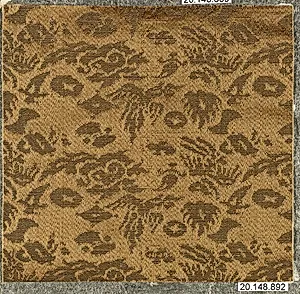
Medium
Silk / Compound weave
Dimensions
4 5/8 × 4 3/4 in. (11.7 × 12.1 cm)
Classification
Textiles-Woven
Culture & Period
China · Qing dynasty (1644–1911)
Department
Asian Art
Museum
Metropolitan Museum of Art, New York, NY
Credit
Gift of Kihei Hattori, in memory of his father, Kihei Hattori, 1920
Accession Number
20.148.892
Rights
Public Domain
Art Historical Context
This exquisite silk textile fragment, dating to the 18th century during China's Qing dynasty (16441911), offers a glimpse into the pinnacle imperial craftsmanship. Measuring just 4 5/8 × 4 3/4 inches, this small "Piece" from the Metropolitan Museum of Art's Asian Art collection exemplifies the's luxurious woven textiles, likely part of a larger garment, robe, or furnishing. The Qing period was renowned for its economic prosperity and cultural refinement, where silk production flourished as a symbol of status and sophistication, traded along the Silk Road and beyond. Crafted in a compound weave—a sophisticated technique that interlaces multiple layers of silk threads to create intricate, reversible patterns in a single loom process—this piece highlights the technical mastery of Chinese weavers. Silk, prized for its luster and durability, was reserved for elite circles, often featuring motifs like dragons, florals, or geometrics that conveyed harmony and imperial power. Though the artist remains unknown, such textiles embodied the Qing's fusion of artistry and innovation. Generously donated in 1920 by Kihei Hattori in memory of his father, this fragment invites visitors to appreciate the tactile beauty and historical depth of Chinese textile traditions, bridging centuries of cultural exchange.