
Piece
Unknown Artist
18th century
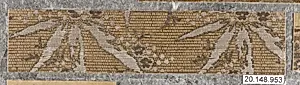
Medium
Silk / Compound weave
Dimensions
1 1/4 × 5 1/2 in. (3.2 × 14 cm)
Classification
Textiles-Woven
Culture & Period
Japan · Edo period (1615–1868)
Department
Asian Art
Museum
Metropolitan Museum of Art, New York, NY
Credit
Gift of Kihei Hattori, in memory of his father, Kihei Hattori, 1920
Accession Number
20.148.953
Rights
Public Domain
Art Historical Context
This exquisite silk textile fragment, woven in a compound technique during Japan's Edo period (1615–1868), offers a glimpse into the refined artistry of 18th-century craftsmanship. Measuring just 1¼ × 5½ inches, this small "Piece" likely originated as part of a larger garment, such as a kimono or obi sash, where such intricate weaves adorned the elite. The Edo era, a time of relative peace and economic growth under the Tokugawa shogunate, saw textiles become symbols of status and cultural sophistication, blending functionality with opulent design. The compound weave method—where multiple warp and weft layers interlace to create complex patterns in a single process—highlights the technical mastery of Japanese weavers. Using fine silk threads, this technique allowed for rich textures and motifs, often inspired by nature, seasons, or auspicious symbols, though specifics here remain tantalizingly elusive due to its fragmentary state. Such pieces were labor-intensive, produced in workshops like those in Nishijin, Kyoto, fueling a vibrant trade. Generously gifted to the Metropolitan Museum of Art in 1920 by Kihei Hattori in memory of his father, this artifact preserves the elegance of Edo-era Japan, inviting us to appreciate the delicate interplay of fiber and history in everyday luxury.