
Piece
Unknown Artist
18th century
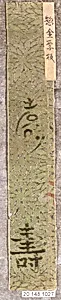
Medium
Silk / Compound weave
Dimensions
8 in. × 1 1/4 in. (20.3 × 3.2 cm)
Classification
Textiles-Woven
Culture & Period
Japan · Edo period (1615–1868)
Department
Asian Art
Museum
Metropolitan Museum of Art, New York, NY
Credit
Gift of Kihei Hattori, in memory of his father, Kihei Hattori, 1920
Accession Number
20.148.1027
Rights
Public Domain
Art Historical Context
This exquisite silk fragment, woven in a compound technique during Japan's Edo period (1615–8), offers a glimpse into the refined artistry of 18th textile production. Measuring just 8 × 1¼ inches, this narrow "Piece" likely served as part of a larger garment, sash, or decorative banding, showcasing the precision of Japanese weavers who crafted luxurious fabrics for the thriving merchant and samurai classes. Donated to the Metropolitan Museum of Art 1920 by Kihei Hattori in memory of his father, it exemplifies the enduring appreciation for these delicate treasures. The Edo era, a time of relative peace and cultural flourishing, saw textiles evolve into high art forms. Silk, prized for its luster and versatility, was transformed through compound weaving—a sophisticated method using multiple warp and weft systems to create intricate, multi-layered patterns without additional embroidery. This technique allowed for complex motifs like florals, geometrics, or landscapes, reflecting ukiyo-e influences and seasonal symbolism central to Japanese aesthetics. As a woven textile from the Asian Art collection, this piece highlights Japan's mastery of kasuri (ikat) or patterned silks, symbols of status and craftsmanship. Though its full design is subtle in scale, it invites visitors to marvel at the labor-intensive looms and dye processes that made Edo fabrics coveted worldwide, bridging everyday elegance with timeless cultural heritage.