
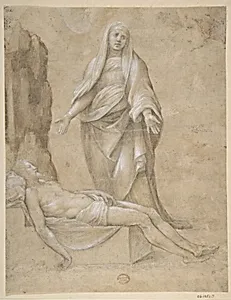
Pieta (recto); Madonna and two Cherubs in pen and brown ink; copy of a drawing in the Louvre which is attributed to Raphael (verso)
16th century
Medium
Brush and brown ink highlighted with white
Dimensions
10 1/4 x 8 in. (26 x 20.3 cm)
Classification
Drawings
Department
Drawings and Prints
Museum
Metropolitan Museum of Art, New York, NY
Credit
Rogers Fund, 1906
Accession Number
06.1051.7
Rights
Public Domain
Tags
Art Historical Context
This double-sided drawing from the 16th century captures the profound emotion of the Pietà on its recto, depicting the Virgin Mary cradling the lifeless body of Christ. Created with brush and brown ink heightened by white, the work exemplifies Raphael’s masterful ability to convey tenderness and sorrow through fluid lines and delicate shading. As a leading figure of the High Renaissance, Raphael infused such devotional subjects with balanced composition and human warmth, reflecting the era’s renewed interest in classical harmony and emotional depth. The medium itself highlights the artist’s technical skill, using ink washes and white highlights to model forms with almost sculptural volume on paper. Drawings like this served as vital studies for larger paintings or frescoes, revealing the creative process behind Renaissance masterpieces. The verso, a pen-and-ink copy of a Louvre sheet also linked to Raphael, shows the Madonna with two cherubs, underscoring the artist’s recurring exploration of maternal grace and divine figures. Acquired by the Metropolitan Museum in 1906, this intimate work offers visitors a rare glimpse into Raphael’s world, where themes of sacrifice, love, and redemption resonated deeply within both religious and artistic traditions of the time.