
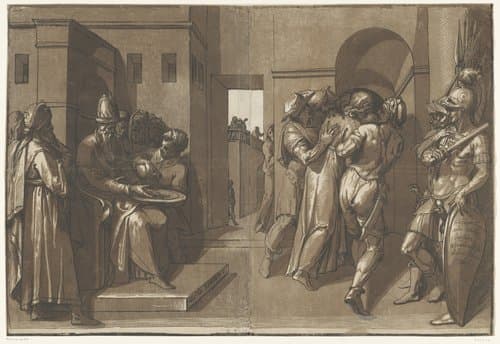
Pilatus wast zijn handen in onschuld
1585
Medium
chiaroscuro woodcut
Dimensions
644; 439
Rights
Public Domain
About this artwork
blad: hoogte 439 mm x breedte 644 mm
Art Historical Context
**Pilatus Wast Zijn Handen in Onschuld (Pilate Washes His Hands in Innoc)** Andrea Andreani 1585 Chiaroscuro woodcut 439 × 644 mm Behold Andrea Andreani's striking chiaroscuro woodcut from 1585, depicting the biblical moment when Pontius Pilate washes his to symbolize his innocence in Christ's sentencing—a poignant scene from the Gospel of Matthew. Created during the late Renaissance in Italy, this large-scale print (nearly half a meter tall and over half a meter wide) captures a dramatic moment of moral ambiguity, reflecting the era's deep engagement with religious narratives amid the Counter-Reformation. Andreani, a masterful Mantuan printmaker (1540–1623), revived the chiaroscuro technique, using multiple woodblocks inked in contrasting tones—typically black and a colored block—to mimic the chiaroscuro effects of oil paintings by masters like Titian or Correggio. This innovative method brought sculptural depth and luminous modeling to prints, making them affordable yet painterly alternatives to costly originals. As one of Andreani's key works, it exemplifies the technical virtuosity of 16th-century Italian printmaking, bridging painting and graphic arts for wider audiences. This piece invites reflection on power, responsibility, and faith, its bold contrasts drawing viewers into the tension of the scene. A testament to Renaissance ingenuity, it remains a highlight for lovers of historical prints.