
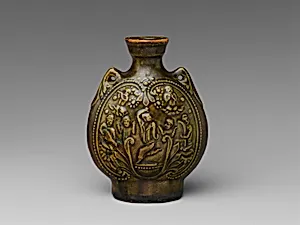
北齊 胡人舞伎紋青釉陶扁壶|Pilgrim’s flask with Central Asian dancers
Unknown Artist
late 6th century
Medium
Earthenware with molded decoration under olive-green glaze
Dimensions
H. 4 3/4 in. (12.1 cm)
Classification
Ceramics
Culture & Period
China · Northern Qi dynasty (550–577)
Department
Asian Art
Museum
Metropolitan Museum of Art, New York, NY
Credit
Purchase, Mr. and Mrs. William P. Frankenhoff and Mrs. Richard E. Linburn Gifts, 2001
Accession Number
2001.629
Rights
Public Domain
Tags
Art Historical Context
This exquisite pilgrim’s flask, crafted in the late 6th during China’s Northern Qi dynasty (–577), captures a vibrant moment of cultural exchange along the Silk Road. Shaped as a flattened, portable vessel—ideal for travelers or pilgrims—the earthenware piece stands just 4 3/4 inches (12.1 cm) tall. Its surface features molded decorations of Central Asian dancers, as "Hu ren," lively figures from the western regions who brought exotic music and performance to Chinese courts, reflecting the dynasty’s openness to foreign influences amid political fragmentation. The artwork’s olive-green glaze, an early lead-based innovation, covers finely detailed molded scenes, showcasing advanced ceramic techniques of the era. This low-fired earthenware with relief decoration highlights Northern Qi potters’ skill in combining functionality with storytelling, where everyday objects became canvases for social life. Housed in the Metropolitan Museum of Art’s Asian Art department (purchase, Mr. and Mrs. William P. Frankenhoff and Mrs. Richard E. Linburn Gifts, 2001), this flask offers a window into a cosmopolitan China, where dancers symbolized joy and connectivity across vast empires. A delightful glimpse of ancient revelry!