
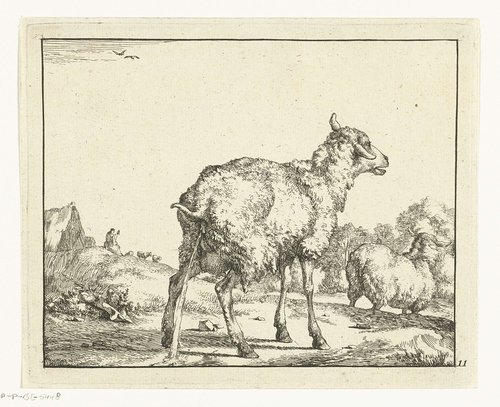
Pissend schaap
1664
Medium
etching
Dimensions
118; 146
Rights
Public Domain
About this artwork
verzamelaarsmerk, verso, gestempeld: Lugt 240
Art Historical Context
### Pissend Schaap (Pissing Sheep) Created in 1664 by Dutch etcher Marcus de Bye, *Pissend Schaap* (Pissing Sheep) is a compact etching measuring 118 × 146 mm, offering an intimate glimpse into 17th-century pastoral life. De Bye, active during the Dutch Golden Age, was renowned for his precise animal studies, capturing the everyday behaviors of livestock like sheep with remarkable realism. This small-scale print exemplifies the era's fascination with nature and the natural world, often depicted in meticulous detail to appeal to collectors and scholars. Etching, de Bye's favored medium, involved coating a metal plate with acid-resistant ground, scratching lines through it, and immersing it in acid to "bite" the design. This technique allowed for delicate textures, such as the sheep's woolly fleece and fluid posture, rendered with fine lines that convey both anatomical accuracy and subtle humor in the animal's unselfconscious act. Such works highlight the technical innovations of Dutch printmaking, rivaling masters like Rembrandt. On the verso, a stamped collector's mark (Lugt 240) identifies its provenance from the esteemed Printroom of the Rijksmuseum, Amsterdam, affirming the artwork's historical value. For visitors, this piece invites reflection on how Golden Age artists elevated humble subjects into enduring art, blending observation with artistry. (198 words)