
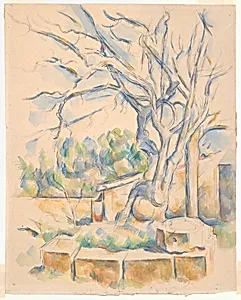
Pistachio Tree at Château Noir
c. 1900
Medium
Watercolor with graphite on cream wove paper, laid down on tan wove paper
Dimensions
54.2 × 43.3 cm (21 3/8 × 17 1/16 in.)
Classification
watercolor
Department
Prints and Drawings
Museum
Art Institute of Chicago
Accession Number
25838
Rights
Public Domain
Art Historical Context
In the late stages of his career, Paul Cézanne, the pioneering Post-Impressionist painter captured the rugged beauty of Provence in *Pistachio Tree at Noir* (c. 1900). Nestled near Aix-en-Provence, the Château Noir was one of Cézanne's subjects, a rocky outcrop he painted obsessively to explore the geometry and volume hidden within nature. This watercolor reflects his lifelong quest to reconcile Impressionist light with a more structural approach, influencing modern masters like Picasso and Matisse. Rendered in watercolor with graphite on cream wove paper—laid down on tan wove for preservation—the work showcases Cézanne's masterful handling of the medium's transparency. Delicate washes build depth and luminosity, while graphite underdrawing provides precise contours, allowing the pistachio tree to emerge as a vibrant focal point amid layered foliage and stone. At 54.2 × 43.3 cm, its intimate scale invites close contemplation, housed today in the Art Institute of Chicago's Prints and Drawings Department. Cézanne's late watercolors, like this one, are celebrated for their proto-Cubist deconstruction of form, treating landscape as a series of interlocking planes. They reveal his philosophy: "Treat nature by means of the cylinder, the sphere, the cone," making this piece a bridge to 20th-century art and a testament to his enduring love for the South of France.
About the Artist
Paul Cezanne · 1839–1906
Paul Cézanne (1839–1906), born in Aix-en-Provence to a prosperous banker father, Louis-Auguste, and mother Anne-Elisabeth-Honorine Aubert, grew up in a bourgeois family that later acquired the Jas de Bouffan estate, where he painted his earliest murals. As a youth, he formed the inseparable trio "Les Trois Inséparables" with schoolmates Émile Zola and Baptistin Baille. Despite his father's wishes ...