
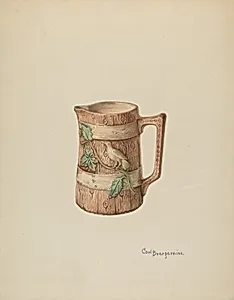
Pitcher
c. 1940
Medium
watercolor, pen and ink, and graphite on paperboard
Dimensions
overall: 36.7 x 28.7 cm (14 7/16 x 11 5/16 in.)
Classification
Index of American Design
Department
CG-W
Museum
National Gallery of Art, Washington, D.C.
Credit
Index of American Design
Accession Number
1943.8.7180
Rights
Public Domain
Art Historical Context
This exquisite rendering of a *Pitcher*, created around 1940 by artist Carl Buergerniss, the charm of everyday American craftsmanship as part of the Index of American Design. Sponsored by the Works Progress Administration (WPA) during the Great Depression this ambitious project (1935–1942) employed artists to document the nation's folk art, decorative objects, and design heritage through meticulous illustrations. Buergerniss, a skilled draftsman known for his precise yet evocative style, contributed numerous works to the Index, preserving artifacts that might otherwise fade from view. Executed in watercolor, pen and ink, and graphite on paperboard (36.7 x 28.7 cm), the piece exemplifies the Index's signature technique: delicate color washes for form and texture, fine ink lines for intricate details, and graphite for subtle shading. This multi-medium approach allowed artists to replicate the original object's gleam, pattern, and patina with photographic accuracy while adding an artistic warmth. Housed in the National Gallery of Art's collection, this work highlights the cultural significance of humble household items like pitchers—symbols of American ingenuity and regional traditions. It invites visitors to appreciate how such designs wove into daily life, bridging art history with the stories of ordinary makers.
About the Artist
Carl Buergerniss · 1877–1956
**Carl Buergerniss** (1877–1956) was an American artist born in Philadelphia, Pennsylvania, who later made his home in Island Heights, New Jersey. He studied at the Pennsylvania Academy of the Fine Arts, a leading institution that shaped many American artists of his era, and exhibited there regularly from 1901 to 1930. While specific teachers are not documented in available sources, his training a...