
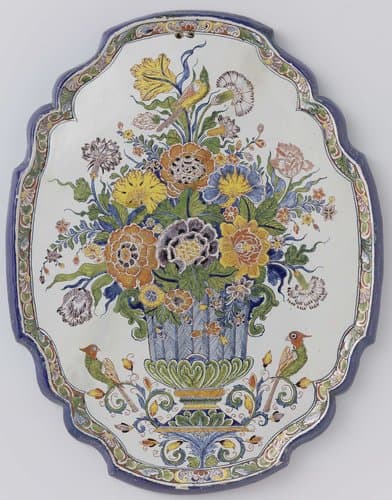
Plaat, ovaal met uitgeschulpte rand, veelkleurig beschilderd met een vaas met bloemen
ca. 1755 - ca. 1780
Dimensions
2; 55; 43
Rights
Public Domain
About this artwork
Plaat, ovaal met uitgeschulpte rand, van faïence. Veelkleurig beschilderd met een vaas met bloemen.
Art Historical Context
This elegant oval plate, crafted from faience around 1755–1780, showcases the refined artistry of anonymous European potters during the Rococo era. Its scalloped edge adds a delicate, shell-like flourish, evoking the ornate tastes of 18th-century dining tables, while the dimensions—approximately 55 cm high, 43 cm wide, and 2 cm deep—suggest it served as both a functional dish and a decorative centerpiece. Faience, a tin-glazed earthenware prized for its glossy surface and vibrant colors, allowed artisans to mimic expensive Chinese porcelain at a more accessible price. The plate's polychrome painting features a central vase brimming with flowers, a popular motif symbolizing abundance and the fleeting beauty of nature. This technique involved applying pigments over an unfired glaze, then firing to achieve lasting luminosity, highlighting the skill of workshop traditions likely from regions like the Netherlands or France. Though unattributed to a single artist, such pieces reflect the cultural boom in colorful ceramics amid growing trade and middle-class prosperity, inviting us to imagine lively 18th-century gatherings where floral splendor brightened everyday meals.
About the Artist
anonymous
In the vast tapestry of art history, "Anonymous" stands not as a singular individual but as a collective designation for countless unidentified creators whose works have endured across millennia. These artists, spanning prehistoric cave painters to medieval illuminators and folk craftsmen, produced the foundational layers of human visual culture. Prior to the Renaissance, when individual fame emer...