
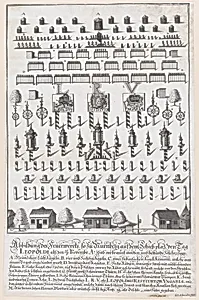
Plan for the fireworks display in honor of Emperor Leopold, Nuremberg, November 15, 1686
after 1686
Medium
Engraving
Dimensions
Sheet (Trimmed): 19 11/16 × 12 7/8 in. (50 × 32.7 cm)
Classification
Prints|Prints-Fete|Ornament & Architecture
Department
Drawings and Prints
Museum
Metropolitan Museum of Art, New York, NY
Credit
Harris Brisbane Dick Fund, 1953
Accession Number
53.600.3600
Rights
Public Domain
Tags
Art Historical Context
This engraving by G.I. Schneider captures the elaborate design for a grand fireworks display staged in Nuremberg on November 15, 1686, to honor Holy Roman Emperor Leopold I. Created shortly after the event, the print preserves the temporary spectacle in meticulous detail, showing architectural frameworks, pyrotechnic arrangements, and ornamental elements typical of Baroque celebrations. As a work on paper measuring roughly 20 by 13 inches, it served both as a commemorative record and a means to share the festivities with a wider audience beyond those who witnessed the live event. In the late seventeenth century, such fireworks displays were important expressions of imperial power and civic pride, transforming public spaces into stages of light and sound. Schneider’s engraving belongs to the tradition of fête prints, which documented ephemeral entertainments while highlighting the intersection of architecture, ornament, and technology. The medium allowed these intricate designs to circulate among collectors and courts, ensuring the memory of the Nuremberg celebration endured long after the sparks had faded. Today, the work offers modern viewers a vivid glimpse into the theatrical culture of the Baroque era and the role of printmaking in preserving historical moments.