
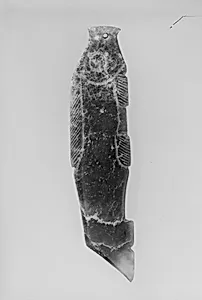
商至西周 玉鱼|Plaque in the shape of a fish
Unknown Artist
Medium
Jade (nephrite)
Dimensions
H. 3 3/8 in. (8.6 cm); W. 13/16 in. (2.1 cm)
Classification
Jade
Culture & Period
China · Shang (ca. 1600–1046 B.C.)–Western Zhou dynasty (1046–771 B.C.)
Department
Asian Art
Museum
Metropolitan Museum of Art, New York, NY
Credit
Fletcher Fund, 1924
Accession Number
24.170.16
Rights
Public Domain
Tags
Art Historical Context
This exquisite jade plaque, carved in the shape of a fish, dates to the Shang dynasty (ca. 1600–1046 B.C.) through the Western Zhou dynasty (1046–771 B.C.), a formative era in ancient Chinese civilization marked by the rise of bronze ritual vessels and early urban centers. Crafted from nephrite jade—a tough, translucent green stone revered in China for its purity and durability—this small ornament (H. 3 3/8 in.; W. 13/16 in.) exemplifies the masterful lapidary skills of the period. Nephrite was not just a material but a symbol of virtue and immortality, often reserved for elites in burials or as status symbols. The fish form holds cultural resonance, evoking abundance and harmony in Chinese symbolism, where the creature's scales and fluid lines suggest movement through water. Likely worn as a pendant or sewn onto garments, it reflects the Shang-Western Zhou transition, when jade carving evolved from ritual blades to intricate animal motifs. Techniques involved grinding, drilling, and polishing with abrasives, achieving a smooth, lustrous finish that highlights the stone's natural veining. Now in the Metropolitan Museum of Art's Asian Art collection (Fletcher Fund, 1924), this plaque offers a window into prehistoric China's aesthetic sophistication, bridging Neolithic traditions with the Bronze Age's grandeur. A delicate treasure, it invites visitors to ponder the enduring allure of jade in shaping identity and cosmology.