
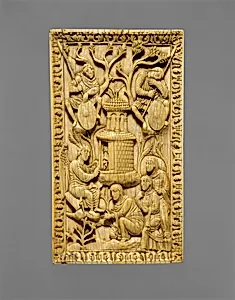
Plaque with the Holy Women at the Sepulchre
Unknown Artist
early 10th century
Medium
Elephant ivory
Dimensions
Overall: 7 1/2 x 4 1/4 x 5/16 in. (19 x 10.8 x 0.8 cm)
Classification
Ivories-Elephant
Culture
North Italian
Department
The Cloisters
Museum
Metropolitan Museum of Art, New York, NY
Credit
Purchase, The Cloisters Collection and Lila Acheson Wallace Gift, 1993
Accession Number
1993.19
Rights
Public Domain
Tags
About this artwork
This Plaque with the Holy Women at the Sepulchre dating to early 10th century exemplifies the artistic traditions of North Italian. Created in elephant ivory, the work demonstrates technical mastery of materials and processes characteristic of North Italian artisans. As part of the Metropolitan Museum of Art's The Cloisters, this piece contributes to our understanding of historical artistic production. The work's Overall: 7 1/2 x 4 1/4 x 5/16 in. (19 x 10.8 x 0.8 cm) and material qualities refle...
Art Historical Context
This exquisite ivory plaque, created in northern Italy during the early 10th century, captures the biblical moment when the Holy Women arrive at Christ’s sepulchre. The scene features the women encountering angels beside the empty tomb, with sleeping guards nearby—a powerful reminder of Resurrection story central to medieval devotion. Carved elephant ivory, the small panel measures just 7½ by 4¼ inches, yet its delicate relief work highlights the extraordinary skill of North Italian artisans who transformed precious materials into objects of spiritual significance. Ivory carving flourished in early medieval Europe as a medium reserved for the most treasured liturgical items, such as book covers and reliquaries. Its smooth surface allowed for fine detail while its rarity and luminous quality conveyed both wealth and sanctity. Housed today in the Metropolitan Museum’s Cloisters, this plaque offers visitors a direct connection to the artistic networks and religious practices of 10th-century Italy. The work’s survival speaks to the enduring value placed on such ivories across centuries. Through its compact yet expressive composition, it illuminates how biblical narratives were made vivid and portable for clergy and laity alike during a formative period of European art.