
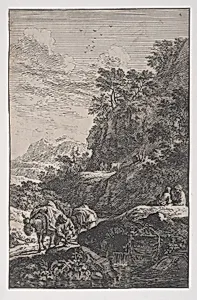
Plate 1: a peasant checking the hoof of his mule by a stream, from 'Landscapes in the manner of Salvator Rosa' (Die Landschaften in Sal. Rosa's)
ca. 1700–25
Medium
Etching
Dimensions
Sheet (Trimmed): 9 1/4 × 5 7/8 in. (23.5 × 15 cm)
Classification
Prints
Department
Drawings and Prints
Museum
Metropolitan Museum of Art, New York, NY
Credit
Harris Brisbane Dick Fund, 1917
Accession Number
17.3.1369
Rights
Public Domain
Art Historical Context
In the early 18th century, artist Franz Joachim Beich this etching, *Plate 1: a peasant checking the hoof of mule by a stream*, part of his series *Landscapes in manner of Salvator Rosa Salvator Rosa, a celebrated 17th-century Italian Baroque master, was renowned for his dramatic, rugged landscapes infused with wild scenery and romantic solitude. Beich, active around 1700–, paid homage to Rosa's style, blending pastoral scenes with a sense of untamed nature that captivated European audiences during the Baroque-to-Rococo transition. The intimate composition captures a humble peasant tending to his mule beside a babbling stream, evoking everyday rural life amid craggy rocks and foliage. Etching, Beich's chosen medium, allowed for precise, expressive lines that mimic the spontaneity of drawing—ink bitten into a metal plate to create rich tonal contrasts and intricate textures. Trimmed to just 9¼ × 5⅞ inches, this print was designed for collectors, reflecting the era's booming market for affordable reproductive art that democratized high-style landscapes. Housed in the Metropolitan Museum of Art's Drawings and Prints department (Harris Brisbane Dick Fund, 1917), this work highlights how artists like Beich sustained Rosa's influence, bridging Italian grandeur with Northern European sensibilities and inviting viewers to ponder the quiet poetry of the countryside.