
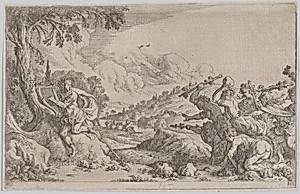
Plate 100: The death of Orpheus, from 'Ovid's Metamorphoses'
Medium
Etching
Dimensions
Sheet (Trimmed): 5 3/16 × 8 3/16 in. (13.2 × 20.8 cm)
Classification
Prints
Department
Drawings and Prints
Museum
Metropolitan Museum of Art, New York, NY
Credit
Gift of Harry G. Friedman, 1962
Accession Number
62.635.621
Rights
Public Domain
Art Historical Context
This etching by Johann Wilhelm Baur captures the dramatic death of Orpheus, the legendary musician Ovid’s Metamorphoses. In the scene, the poet is torn apart by frenzied Maenads after rejecting their advances, his lyre abandoned beside him. Created in 1641 as Plate 100 in a printed series, the work brings to life one of antiquity’s most poignant tales of art, love, and violent transformation. Baur, a German etcher active during the Baroque era, specialized in illustrating classical literature for a growing audience of print collectors. Etching allowed him to render intricate details and dynamic movement on a modest scale—the sheet measures just over five by eight inches—making mythological narratives accessible beyond palace walls. Such series helped spread Ovid’s stories across Europe in the seventeenth century, blending scholarly interest with popular entertainment. Today, this impression in the Metropolitan Museum’s collection reminds us how prints served as both art and storytelling devices, preserving ancient myths for new generations through delicate line and expressive composition.
About the Artist
Johann Wilhelm Baur · 1607–1642
Johann Wilhelm Baur was a German draughtsman, painter, and printmaker who came of age in the early seventeenth century and built his reputation through the production of finely detailed illustrations and miniatures. Though the precise details of his training remain incompletely documented, Baur developed his skills in the tradition of German and Northern European graphic art, showing influences fr...