
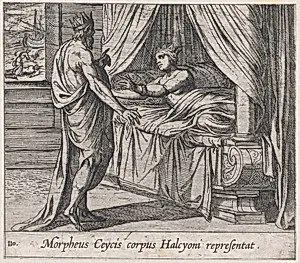
Plate 110: Morpheus, as Ceyx, Appearing to Alcyone (Morpheus Ceycis corpus Halcyoni representat), from Ovid's 'Metamorphoses'
1606
Medium
Etching
Dimensions
Sheet: 4 in. × 4 5/8 in. (10.2 × 11.7 cm)
Classification
Prints
Department
Drawings and Prints
Museum
Metropolitan Museum of Art, New York, NY
Credit
The Elisha Whittelsey Collection, The Elisha Whittelsey Fund, 1951
Accession Number
51.501.3961
Rights
Public Domain
Tags
Art Historical Context
In Antonio Tempesta's etching *Plate 110: Morpheus, as Ceyx, Appearing to Alcyone* (1606), we witness a poignant moment from Ovid's *Metamorphoses*. The god of dreams, Morpheus, shapeshifts into the drowned king Ceyx to visit his grieving wife Alcyone in her sleep. Perched on her bed, the spectral Ceyx—dripping with seawater—reveals his fate from a shipwreck, blending tragedy and the supernatural in a scene rich with emotion. This print is part of Tempesta's renowned series of 140 etchings illustrating Ovid's epic tales of transformation, which captivated Renaissance and Baroque audiences fascinated by classical mythology. Tempesta, a prolific Florentine artist (1555–1630), mastered etching to create dynamic, intricate compositions on a intimate scale—here, just 4 x 4⅝ inches. His fluid lines and dramatic contrasts evoke movement and pathos, hallmarks of early Baroque printmaking. Etchings like this were affordable and widely disseminated, popularizing Ovid's stories across Europe and influencing later artists from Rubens to Rembrandt. Housed in the Metropolitan Museum of Art's Prints collection, this work highlights the era's revival of antiquity, where myths explored love, loss, and metamorphosis. Imagine Alcyone's shock upon waking—Tempesta captures that timeless drama in miniature brilliance.
About the Artist
Antonio Tempesta · 1555–1630
Antonio Tempesta (1555–1630), known as 'Il Tempestino,' was a Florentine painter and printmaker whose extraordinary output of approximately 1,700 etchings made him one of the most influential printmakers of the early Baroque period. Born in Florence and trained under Santi di Tito and the Flemish master Joannes Stradanus, he enrolled in the Accademia del Disegno in 1576 before relocating to Rome i...