
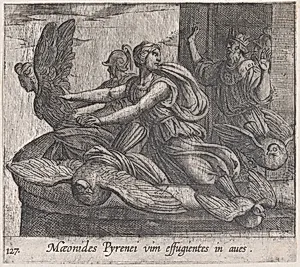
Plate 127: Anius's Daugthers Changing into Birds (Maeonides Pyrenei vim effugientes in aves), from Ovid's 'Metamorphoses'
1606
Medium
Etching
Dimensions
Sheet: 4 1/8 × 4 9/16 in. (10.4 × 11.6 cm)
Classification
Prints
Department
Drawings and Prints
Museum
Metropolitan Museum of Art, New York, NY
Credit
The Elisha Whittelsey Collection, The Elisha Whittelsey Fund, 1951
Accession Number
51.501.3978
Rights
Public Domain
Tags
Art Historical Context
Behold Plate 127 from Antonio Tempesta's masterful etching series illustrating Ovid's *Metamorph*, created in 1606. This intimate 4⅛ × 4⁹⁄₁₆-inch sheet captures a dramatic moment from the Roman poet's epic: the daughters of Anius, king of Delos, transforming into birds to escape peril. In Ovid's tale, the women—gifted with miraculous powers by Bacchus—are pursued amid themes of divine intervention and metamorphosis, symbolized here by fluttering wings and frantic motion. Tempesta, a prolific Italian Mannerist etcher active in late Renaissance Rome, excelled in dynamic, narrative-packed prints like this one, part of his ambitious 138-plate suite based on Ovid's poem. His etching technique—using acid to incise fine, expressive lines on a copper plate—brings mythological chaos to life with remarkable detail and energy, making classical stories accessible to 17th-century collectors and scholars. These small-scale works were prized for their portability and vivid storytelling. Housed in the Metropolitan Museum of Art's Drawings and Prints department, this piece from The Elisha Whittelsey Collection highlights the enduring cultural fascination with Ovid's transformations, blending antiquity with early modern artistry. A tiny window into myth's magic!
About the Artist
Antonio Tempesta · 1555–1630
Antonio Tempesta (1555–1630), known as 'Il Tempestino,' was a Florentine painter and printmaker whose extraordinary output of approximately 1,700 etchings made him one of the most influential printmakers of the early Baroque period. Born in Florence and trained under Santi di Tito and the Flemish master Joannes Stradanus, he enrolled in the Accademia del Disegno in 1576 before relocating to Rome i...