
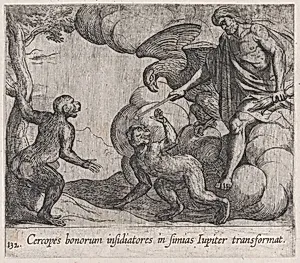
Plate 132: Jupiter Changing the Cercopians into Monkeys (Cercopes bonorum insidiatores in Simias Iupiter transformat), from Ovid's 'Metamorphoses'
1606
Medium
Etching
Dimensions
Sheet: 4 in. × 4 1/2 in. (10.2 × 11.5 cm)
Classification
Prints
Department
Drawings and Prints
Museum
Metropolitan Museum of Art, New York, NY
Credit
The Elisha Whittelsey Collection, The Elisha Whittelsey Fund, 1951
Accession Number
51.501.3983
Rights
Public Domain
Tags
Art Historical Context
This small but dynamic etching by Antonio Tempesta captures a vivid episode from Ovid’s *Metamorphoses*. Plate 132 shows Jupiter punishing the deceitful Cercopians by transforming them into monkeys, their human forms twisting mid-change as the god asserts his authority. Created in 1606, the print belongs to Tempesta’s extensive illustrated series of the ancient Roman poem, which brought mythological tales to a wide audience through affordable, reproducible images. Working in early seventeenth-century Rome, Tempesta was a prolific printmaker whose crisp etching technique allowed for lively detail within a compact format—just four by four-and-a-half inches. The medium’s fine lines effectively convey movement and texture, from fluttering wings of attendant birds to the emerging simian features of the tricksters. Such series helped spread Ovid’s stories across Europe, shaping visual culture long after the Renaissance. Acquired by the Metropolitan Museum of Art through the Elisha Whittelsey Fund, this print exemplifies how prints served both as art and as vehicles for classical learning, inviting viewers to explore themes of transformation, justice, and divine power.
About the Artist
Antonio Tempesta · 1555–1630
Antonio Tempesta (1555–1630), known as 'Il Tempestino,' was a Florentine painter and printmaker whose extraordinary output of approximately 1,700 etchings made him one of the most influential printmakers of the early Baroque period. Born in Florence and trained under Santi di Tito and the Flemish master Joannes Stradanus, he enrolled in the Accademia del Disegno in 1576 before relocating to Rome i...