
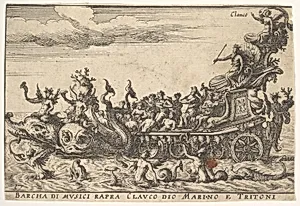
Plate 16: Ship of musicians with the sea god Claucus and tritons (Barcha di musici rapra Clauco dio marino e Tritoni), from the series 'The magnificent pageant on the river Arno in Florence for the marriage of the Grand Duke' (Le Magnifique carousel fait sur le fleuve de l'Arne a Florence, pour le mariage du Grand Duc), for the wedding celebration of Cosimo de' Medici in Florence, 1608
Medium
Etching
Dimensions
Sheet (Trimmed): 3 1/4 × 4 13/16 in. (8.3 × 12.2 cm)
Classification
Prints|Ornament & Architecture
Department
Drawings and Prints
Museum
Metropolitan Museum of Art, New York, NY
Credit
Bequest of Phyllis Massar, 2011
Accession Number
2012.136.527.12
Rights
Public Domain
Tags
Art Historical Context
This enchanting etching, *Plate 16: Ship Musicians with the Sea God Glaucus and Tritons*, a fantastical moment from the lavish 1608 wedding celebrations of Cosimo II de' Medici, Grand Duke of Tuscany, and Maria Magdalena of Austria. Part of the series *The Magnificent Pageant on the River Ar in Florence*, it depicts a mythical barge brimming with musicians, presided over by the sea god Glaucus and playful tritons—half-man, half-fish attendants. These floating spectacles transformed Florence's Arno River into a stage of Baroque splendor, blending classical mythology with Renaissance opulence to glorify the Medici dynasty. Created as an etching in 1664 by a collaborative team including designer Giulio Parigi, etchers Remigio Cantagallina and Jean Sauvé, the small-scale print (just 3¼ × 4⅞ inches) masterfully reproduces intricate details of ornate ships, flowing drapery, and lively figures. Etching's fine lines allowed for precise architectural ornamentation, reflecting the era's fascination with printmaking to disseminate grand events across Europe. Housed in the Metropolitan Museum of Art's Drawings and Prints department, this bequest from Phyllis Massar offers a window into how Medici festivities fused art, theater, and politics, immortalizing Florence's cultural prestige.
About the Artist
Anonymous|Giulio Parigi|Remigio Cantagallina|Jean Sauvé
In the vast tapestry of art history, "Anonymous" stands not as a singular individual but as a collective designation for countless unidentified creators whose works have endured across millennia. These artists, spanning prehistoric cave painters to medieval illuminators and folk craftsmen, produced the foundational layers of human visual culture. Prior to the Renaissance, when individual fame emer...