
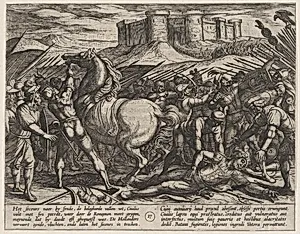
Plate 17: The Romans Misled by Civilis' Horse to Believe that He was Dead or Injured, from The War of the Romans Against the Batavians (Romanorvm et Batavorvm societas)
Medium
Etching, first state of two, issue 1 (Bartsch)
Dimensions
Sheet: 6 7/16 × 8 1/8 in. (16.3 × 20.6 cm)
Classification
Prints
Department
Drawings and Prints
Museum
Metropolitan Museum of Art, New York, NY
Credit
The Elisha Whittelsey Collection, The Elisha Whittelsey Fund, 1951
Accession Number
51.501.3453
Rights
Public Domain
Tags
Art Historical Context
In the dramatic *Plate 17: The Misled by Civilis Horse to Believe that He Dead or Injured*, Otto van Veen's 1611 series *The War of the Romans Against Batavians (Romanorvm et Batavor societas)*, Italian engraver Antonio Tempesta a pivotal moment of deception in the ancient Batavian Revolt. soldiers, weapons drawn amid chaos, swarm toward what they believe is the fallen rebel leader Julius Civilis—only to be tricked by his riderless horse. This etching, in its rare first state (Bartsch), measures just 6 7/16 × 8 1/8 inches, yet pulses with tension through dynamic figures, rearing horses, and swirling dust. The scene draws from Tacitus's accounts of the 69–70 CE uprising, where Batavian chieftain Civilis rallied tribes against Roman oppression along the Rhine. Van Veen, a Flemish artist and Rubens's teacher, designed the series to evoke heroism and strategy, blending classical history with Baroque energy. Tempesta's etching technique—biting acid into metal plates—allowed precise lines and rich tonal contrasts, making these affordable prints popular for educating on antiquity. Held in the Metropolitan Museum of Art's Elisha Whittelsey Collection, this work highlights printmaking's role in disseminating epic narratives, immortalizing themes of warfare, suffering, and cunning that resonated in Europe's own turbulent age.
About the Artist
Antonio Tempesta|Otto van Veen · 1555–1630
Antonio Tempesta (1555–1630), known as 'Il Tempestino,' was a Florentine painter and printmaker whose extraordinary output of approximately 1,700 etchings made him one of the most influential printmakers of the early Baroque period. Born in Florence and trained under Santi di Tito and the Flemish master Joannes Stradanus, he enrolled in the Accademia del Disegno in 1576 before relocating to Rome i...