
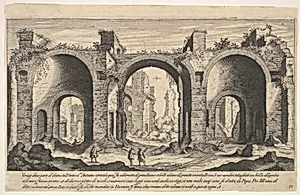
Plate 19: view of the Baths of Caracalla, indicating with inscribed letter 'A' the places from which columns were reportedly taken by Pope Pius IV to be sent to the Grand Duke of Florence, from the series 'Ruins of the antiquity of Rome, Tivoli, Pozzuoli, and other places' (Vestigi della antichità di Roma, Tivoli, Pozzvolo et altri luochi)
Medium
Etching and engraving
Dimensions
Sheet: 6 3/4 x 10 7/16 in. (17.1 x 26.5 cm)
Classification
Prints|Ornament & Architecture
Department
Drawings and Prints
Museum
Metropolitan Museum of Art, New York, NY
Credit
Bequest of Phyllis Massar, 2011
Accession Number
2012.136.716.4
Rights
Public Domain
Tags
Art Historical Context
This 1606 etching and engraving by Aegidius Sadeler II after Etienne DuPérac captures a detailed view of the Baths of Caracalla, one of ancient Rome’s grandest public complexes. Created as Plate 19 in the series *Vestigi della antichità di Roma, Tivoli, Pozzuoli et altri luochi*, the print highlights the enduring fascination with Rome’s ruins during the early modern period. A small inscribed “A” on the sheet marks the precise locations from which columns were reportedly removed by Pope Pius IV in the 1560s and sent to Florence for the Grand Duke, illustrating how ancient materials were repurposed for Renaissance projects. The medium of etching combined with engraving allowed for both precise architectural lines and atmospheric depth, making these prints valuable records for scholars, architects, and travelers. Such series helped shape European understanding of classical antiquity by documenting monuments that were already partially dismantled. Today, this work in the Metropolitan Museum’s collection reminds viewers of the layered history of Rome—where imperial grandeur, papal intervention, and artistic preservation intersect.
About the Artist
Aegidius Sadeler II|Etienne DuPérac · 1568–1629
Netherlandish, Antwerp 1568–1629 Prague