
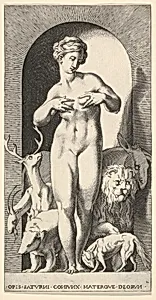
Plate 2: Ops standing in a niche with her hands at her breasts, looking to her left, with animals behind her, from "Mythological Gods and Goddesses"
Medium
Engraving; third state of three (TIB)
Dimensions
Sheet: 8 3/16 × 4 3/16 in. (20.8 × 10.7 cm)
Classification
Prints
Department
Drawings and Prints
Museum
Metropolitan Museum of Art, New York, NY
Credit
The Elisha Whittelsey Collection, The Elisha Whittelsey Fund, 1949
Accession Number
49.97.223
Rights
Public Domain
Tags
Art Historical Context
In this captivating engraving from 1526, titled *Plate 2: Ops in a niche with her at her breasts, looking to her left, with animals behind her*, visitors encounter the Roman goddess Ops, embodiment of abundance and earth fertility (equivalent to Greek Rhea). Designed by the innovative Mannerist painter Rosso Fior and masterfully engraved by Giovanni Jacopo Caraglio, the image frames Ops in an architectural niche, her nude elegantly elongated with hands cupped at her breasts—a gesture evoking nurturing and plenty. Surrounding her are fierce yet protective beasts: lions, bears, and deer, symbolizing her dominion over wild nature and bounty. This is the third (final) state of a plate from the rare series *Mythological Gods and Goddesses*, a Renaissance collaboration that bridged painting and printmaking. Created in Italy during the shift from High Renaissance harmony to Mannerism's graceful distortions, engravings like this one (measuring just 8 3/16 × 4 3/16 inches) democratized elite art, allowing collectors across Europe to own Rosso's bold compositions. Caraglio's precise burin work captures the artist's dynamic poses and intricate details, making complex mythology accessible. Held in The Metropolitan Museum of Art's Elisha Whittelsey Collection, this print highlights the era's revival of classical gods, blending pagan sensuality with Christian-era humanism. It's a window into how 16th-century artists like Rosso used prints to experiment with eroticism and symbolism, inviting us to ponder Ops' enduring role as guardian of earth's riches.
About the Artist
Giovanni Jacopo Caraglio|Rosso Fiorentino · 1500–1565
Italian, Parma or Verona ca. 1500/1505–1565 Krakow (?)