
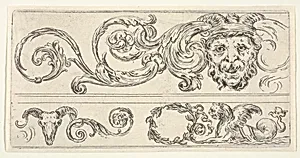
Plate 2: three fragments of friezes; on top, a grotesque head of a man, a skull of a ram at bottom left and a chimera at bottom right, from 'Friezes, foliage, and grotesques' (Frises, feuillages et grotesques)
ca. 1638–43
Medium
Etching
Dimensions
Sheet: 2 7/16 × 4 7/8 in. (6.2 × 12.4 cm)
Classification
Prints|Ornament & Architecture
Department
Drawings and Prints
Museum
Metropolitan Museum of Art, New York, NY
Credit
Bequest of Phyllis Massar, 2011
Accession Number
2012.136.101.2
Rights
Public Domain
Tags
Art Historical Context
Stefano della Bella, a masterful Italian etcher of the Baroque era (1610–1664), created this intricate *Plate 2: three fragments of frie* around 1638–43 as part of his series *Friezes,, and grotesques*Frises, feuill et grotesques*). Working primarily in Florence for the Medici court and later in Paris, della Bella drew inspiration from ancient Roman decorations unearthed during the Renaissance, blending them with the playful extravagance of 17th-century ornamentation. This small etching (2 7/16 × 4 7/8 in.) exemplifies his technical prowess in the medium, using fine, fluid lines to evoke architectural fantasy. The composition features three fantastical frieze fragments: a grotesque, leering head of a man crowns the top, while a ram's skull lurks at bottom left and a chimeric beast—part lion, part goat—growls at bottom right. Grotesques like these, popularized by artists such as Raphael, were staples in Mannerist and Baroque design, adorning everything from frescoes to furniture. Della Bella's etching captures their whimsical horror with remarkable detail, showcasing his ability to pack narrative intensity into a compact space. Housed in the Metropolitan Museum of Art's Drawings and Prints department (Bequest of Phyllis Massar, 2011), this print highlights the era's fascination with mythical motifs and ornamental architecture, inviting viewers to marvel at how such "fragments" fueled the decorative arts across Europe.
About the Artist
Stefano della Bella · 1610–1664
Stefano della Bella (1610-1664) was one of the most prolific and versatile printmakers of the Italian Baroque period, leaving behind 1,052 prints and several thousand drawings that captured the vivid essence of 17th-century European life. Born in Florence on May 18, 1610, to a family of artists, he trained initially as a goldsmith before studying painting under Cesare Dandini and etching under Rem...