
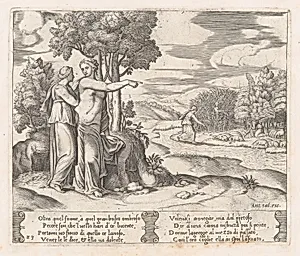
Plate 23: Psyche on the order of Venus departing to find the golden fleece, from "The Story of Cupid and Psyche as told by Apuleius"
Medium
Engraving
Dimensions
Sheet: 10 1/4 × 15 13/16 in. (26 × 40.2 cm) Plate: 7 13/16 × 9 1/16 in. (19.8 × 23 cm)
Classification
Prints
Department
Drawings and Prints
Museum
Metropolitan Museum of Art, New York, NY
Credit
Rogers Fund, transferred from the Library
Accession Number
41.71.3(23)
Rights
Public Domain
Tags
Art Historical Context
This enchanting engraving, *Plate 23: Psyche on the order of Venus departing to find the golden fleece from the series *The Story of Cup and Psyche as told Apuleius*, captures pivotal moment in the ancient Roman tale from Apuleius'The Golden Ass* (2nd century AD). Here, the mortal Psyche, under Venus's cruel command, sets out on her perilous quest for the golden fleece from the world's most fearsome sheep—a task designed to test her endurance amid the goddess's jealousy. Surrounded by shadowy trees, Psyche's determined figure evokes the myth's themes of love, trials, and transformation, which captivated Renaissance audiences rediscovering classical literature. Created between 1530 and 1560, this print reflects the era's artistic revival of antiquity. Designed by Flemish painter Michiel Coxie (I), engraved by the anonymous Master of the Die, and published by Antonio Salamanca in Rome, it exemplifies collaborative printmaking. Engraving, incising lines into a copper plate for inked impressions, allowed intricate details—like Psyche's flowing drapery and textured foliage—to be reproduced widely, democratizing art for collectors across Europe. Measuring a modest plate size of about 8 x 9 inches, its precision highlights the technical mastery of 16th-century print workshops. Housed in the Metropolitan Museum of Art's Drawings and Prints department (Rogers Fund transfer), this piece underscores the cultural bridge between pagan myths and Christian humanism, influencing later Baroque interpretations of the Cupid-Psyche romance. A window into Renaissance ingenuity!
About the Artist
Antonio Salamanca|Master of the Die|Michiel Coxie (I) ( |Italian (born Spain)) · |1478 – |1562
|Salamanca 1478–1562 Rome